BROKEN LINKS: Some of the links in this site use the domain savecombsschool.org.uk.
Because the site is no longer maintained, those links no longer work.
But if you substitute that part of the page's address with savecombsschool.blogspot.com, they will work for you.
Sorry, but there's no time to go back and edit the whole site!

Wednesday, 13 August 2008

Number 10 Responds
to Online Petition

With the characteristic rapidity of national government, Number 10 has today responded to the online petition that ran during the campaign, and which had fulfilled its purpose last October.


"Derbyshire local authority is responsible in law for the organisation of school places in its area and Ministers have no role in the process. However the Government is firmly committed to rural schools, because we recognise that they are an important part of the rural landscape and an important factor in keeping rural communities alive. That is why, to protect rural schools, the Government introduced a presumption against their closure ten years ago. That does not mean that no rural school can ever close, but our statutory guidance makes clear that the case for closure needs to be strong and in the best interests of educational provision in the area.

In making decisions about rural school closures local authorities must have regard to the presumption and must take account of other factors such as transport availability and cost, alternatives to closure and the impact on the local community. We expect authorities to also take account of school performance, as it is our policy that they support popular and successful schools.

On 30 October 2007, in considering the proposals to close Combs Infant School, Derbyshire local authority took account of our guidance, specifically the need to justify rural school closures on the grounds of raising standards, and decided not to proceed with the closure.

We hope the local authority’s decision addresses your concerns and reassures you that we have put in place mechanisms to protect the future of small rural primary schools*.

The Prime Minister sends his best wishes for the future of Combs Infant School."

* Editor's emphasis.

Read the response on the Number 10 web site. The link to the relevant report is here.

Friday, 9 May 2008

A Year Ago Today

A lot can happen in a year. If Derbyshire County Council had got their way, our youngest daughter would have been in her last term at the village school, the place would have been running down in front of our eyes, then dismantled and lost for ever. A piece of history and a slice of excellence in a mediocre world would have been thrown to the four winds with barely a backward glance from the perpetrators of the crime.

But we fought the good fight and we won. This is something to celebrate in a society increasingly crushed by senseless rules and petty bureaucracy, by small-minded people with limited vision and an eye to the main chance and self-aggrandissment. Instead of painfully counting the days till the end of the summer term and the end of an era, facing farewells that should never be and tears that needn’t have been cried, I was able to leave my five year old daughter in the playground this morning happily attempting to jump her spindly little legs over a rope in a brave attempt to learn the art of skipping. The air was soft and warm, the birds were singing, the children were laughing and the cress was bursting through the soil of the grow-bags which they had busily and messily planted last Friday afternoon.

Instead of a sense of heartache and loss, we are able to continue with a sense of well-being, growth and optimism for the future: these children are being given the very best of starts in a beautiful, healthy, sane environment.

I can assure you that the seedlings that come out of this particular grow-bag are strong and vigourous and will grow into beautiful mature plants. They have been given the best of starts in life and they will flourish. These young people are our future and if every child could be given the educational start in life that these children receive, then our world would be a much better place.

Coincidentally on the lunchtime news a youth worker and reformed gang member who was commenting on the brutal knife murder of 16 year old Kodjo Yenga in Hammersmith last year said the problems we are facing with this aggressive youth culture is all down to education. He said that he (as a gang member) was a product of this failure in education. If he can see it, why on earth can’t the people in charge? Why does this government (and others before it) continue to mess up our education system, swamping it with mindless health and safety rules, absurd levels of administration which take away from teaching time and, perhaps most significantly, insisting, in the vein of globalisation, that big is beautiful and that one size fits all? When will they learn that ultimately it is more economical to produce well-educated, well-rounded young people from smaller places of learning than to produce ill-educated dysfunctional people from large anonymous institutions where each child is barely no more than a statistic? This is not rocket science. This is just common sense.

Instead of taking money away from village schools, they should be investing in them. They are the heart of a community, they instill community spirit and a sense of belonging and society to the children whom they educate. It is not just about results and league tables. It is about appreciating what it is to be part of a family, it is about developing self-respect and self-confidence, and understanding what can be achieved by team effort and a positive, optimistic approach to life and learning.

The achievement of our small community in fighting the big boys and beating them at their own game is surely proof enough that small can be beautiful too. We pulled together, we worked as a team, we never gave up and we came out smiling. It can be done.

Tuesday, 29 January 2008

Labour should value
village school benefits

Where was the leader-writer of the Daily Telegraph during our campaign?

This editorial is from today's edition.

How hollow the promise now rings. Fresh into power, Labour's then schools minister, Stephen Byers, pledged in 1998 to give "tough new protection for village schools" to end the "wholesale" closure process that had seen 450 of them shut their doors over the previous decade and a half.

"Closing a village school can be a death-blow to the community," Mr Byers observed. He was absolutely right; regrettably, his promise is now unravelling. Weekend reports of a new purge of village schools on economic grounds suggest that up to 300 are already being targeted for closure and the total could reach 1,000.

This is the unthinking politics of the bean-counter in action. In strictly economic terms, small village schools will never be as cost-effective as larger schools in towns or cities. But their value to a local community cannot be measured solely on a balance sheet.

It is not just that small schools, by and large, are better schools - one day, policy-makers will accept that the failings of many schools are related more than anything else to their sheer size. It is because the local school is the beating heart of a village and if it closes, the community suffers, as Mr Byers wisely noted.

A place that no longer educates its young is sending out a signal that it may not have much of a future. Educating children away from their community will slowly but surely undermine it. As for "joined-up government", how does busing or driving children miles to be educated fit in with the Government's environmental commitments?

Sadly, this casual neglect of rural Britain is symptomatic of a government that sees no votes in the countryside and therefore treats it with something approaching disdain. This attitude was detectable in the plans to close rural post offices, which were scaled down under intense pressure, not least from this newspaper, but will still be pushed through in many areas.

Rural Britain has no clout at the Cabinet table and the result has been the accentuation of the rural/urban split to a dangerous degree - witness the ludicrous amount of parliamentary time devoted to the foxhunting ban.

There is an opportunity here for the Conservative Party, whose exploration of the politics of the "post-bureaucratic" age points towards greater self-reliance and local solutions. This promises to be the key ideological battleground at the next election. Among other things, it should mean that the fate of a village school is decided by the community and not by the pen-stroke of some distant bureaucrat.

Also, in The Observer, 27 January 2008:
Hundreds of village schools face axe and
This will rip the heart out of our community.

Thursday, 1 November 2007

DCC Announces Decision

This press release was issued on 31 October by DCC. See below for some observations.

COMBS INFANT SCHOOL TO STAY OPEN

An infant school threatened with closure is to stay open, Derbyshire County Council’s cabinet has decided.

Members of the cabinet followed a recommendation by education officers to keep Combs Infant School in Chapel-en-le-Frith open.
[NOTE 1]

Before a council can take a decision to close a rural school it has be satisfied – under the terms of the 2006 Education Act – that pupils would receive a better standard of education if they were moved to alternative schools.

Councillors were told that although the nearest alternative school, Chapel-en-le-Frith Primary School, provides a good quality education standards at Combs Infant School are currently higher.

The cabinet decided against closing Combs Infant School but to keep the problem of surplus places in the Chapel-en-le-Frith area under review.

Councillor Alan Charles, cabinet member for schools, said: “Currently there are only seven pupils from the catchment area
[NOTE 2] of Combs that attend the school.

“In theory there could be no pupils from the catchment area but we would still have to keep the school open if we cannot show that educational standards would be improved by moving pupils to an alternative school.

“Keeping the school open means we are providing a costly and privileged education for children not directly from the Combs community
[NOTE 3]. This is at the expense of tax payers and every other child attending a Derbyshire school.”

The cost of educating each pupil at Combs Infant School is £5,447
[NOTE 4], compared to £2,635 at other infant schools [NOTE 5] in the county.

The decision followed an informal public consultation during which there were 180 letters and a petition with 1,687 signatures
[NOTE 6] opposing the proposals to close Combs Infant School.

There were also concerns expressed about the impact that closing the school would have on community groups, who use the same building.

(Ref: JF.375.07) Media enquiries to John Fern on 01629 585234 or email john.fern@derbyshire.gov.uk
[NOTE 7]
OK, ready for the explanation? Go and grab a cup of tea, because the explanation is almost as long as the original press release.

Note 1:That's a subtle one, isn't it? Quite easy to miss on first reading. Combs is not 'in Chapel-en-le-Frith', although if it was it could make sense for all the kids to go to Chapel-en-le-Frith school, couldn't it? Combs is 'in Chapel-en-le-Frith' like St. Albans is 'in London'.

Note 2:DCC told us that there was no such thing as a 'catchment area' any more. So why is Alan Charles referring to it now, how is it defined, and what effect is it supposed to have legally?

Note 3:Similarly, how is 'not directly from the Combs community' defined?

Note 4:That's a budget number, not the actual cost, which is lower. Budgets were most recently discussed here.

Note 5:The £2635 is an average for primary schools, not infant schools as stated here.

Note 6:They're still getting the petition numbers wrong. There were 2141 signatures - that's about three times the population of our small village of Combs. They're out by about 20%. Not enough to matter? The amount they're wrong by is about two-thirds the population of Combs. What else do you think they'll have got wrong?

Note 7:Just in case you think that these press releases could be misleading by accident, this is what DCC's press officer told us: "All press releases are approved by the senior officers involved in the particular issue concerned and by the relevant cabinet member. If there are legal issues involved they are also checked by one of our lawyers."

School Closure Plan Was Vandalism

This letter appeared in today's Buxton Advertiser. It comes from Barrie Taylor, County Councillor for Whaley Bridge & Blackbrook. He is the Liberal Democrat Group Leader on the Council.

The County's grudging agreement not to close Combs Infant School is a huge relief to the local community, and a great credit to all those who have campaigned so hard and so effectively to keep the school open.

Barrie TaylorHowever, joy at the decision is tempered by annoyance that the closure procedure was ever started, and that it was allowed to go on for so long.

The final report to Cabinet recommended that the school should survive, but hardly referred to all the compelling evidence provided by the school governors and the local campaigners. The decision was based entirely on the fact that closure of the only "Outstanding" school in the area, as declared by Ofsted inspectors, could not improve local standards of education. That was glaringly obvious from the outset.

It soon became apparent that none of the other criteria that are set by the Government for the closure of rural schools were met, as the school is also the village hall, and there would be no benefit to other schools that are experiencing falling school rolls.

At the original public meeting I asked for the closure process to be stopped straight away, as the evidence was already so conclusive.

Councillor Alan Charles, Cabinet member for schools, continued to insist that the process had to grind on to the end, despite clear government guidance that it could be stopped at any time. He subsequently accused me of making a "grandstanding speech to get a cheap round of applause".

In the attempt to justify the original proposal to close the school the Council continue to quote inflated figures of the cost per pupil at Combs, despite the Ofsted report stating that it gives "outstanding value for money".

Pupils at Combs are very lucky to be able to attend such an excellent school in lovely surroundings, and it would be wonderful if all infants in the County could have the same experience.

However to propose closing Combs school because this is not possible is the politics of envy.

At the outset I said that to close this centre of excellence at Combs, without any benefit elsewhere, would be an act of vandalism.

The report to Cabinet of the County's education officers comes to the same conclusion, in more diplomatic language.

Peak School Wins the Battle, but Fears a War

Report from today's Buxton Advertiser.

"IT IS a battle won, but not the war," was the reaction from one delighted parent this week after Combs Infants School was saved from closure.

Members of Derbyshire County Council's Cabinet agreed with an officer's recommendation to keep the school open when they met on Tuesday.

Campaigners, who have spent the last six months fighting the plans, were delighted with the decision, but feel there is still more work to be done.

Parent Carah Boden said: "It is a battle won, but not the war. We need to try and stabilise the situation. Now all this is behind us, we need to ensure its ongoing future."

Chair of governors Nye Rowlands added: "We need to move on from this decision, and work with Derbyshire Council to remedy the damage that has been done by their threat to close the school.

"The cabinet said that if you put a lot of money into a school, it is going to be excellent but if you look around Derbyshire, Cheshire or the rest of the country, putting a lot of money into schools does not bring excellence. Being in the top ten per cent of schools in the country, Combs Infant School didn't achieve that through money. It achieved it through the standards of the teachers.

"We have now got to generate an even closer relationship with the community who are very much part of the school. They have stood by us and supported us and the parents have stood by us.

"This has proved a cause which everybody can unite behind."

High Peak Borough councillor Andrew Bingham has supported the campaign group for several months. He said: "There is still a war to be fought and I feel sure that the council will probably revisit the matter again given half a chance.

"When that will be I don't know.

"I'd like to pay tribute to the campaign group for everything they did. Education committe chairman Alan Charles mentioned it had been a well constructed and polite campaign and that is a tribute to the people who have organised it."

Derbyshire County Councillor Barrie Taylor, who represents the Whaley and Blackbrook ward, which covers Combs, added: "I'd like to thank everybody who ran the most impressive campaign in support of the school, which has brought all the community together."

The campaign group are holding a celebration at the school on November 9 to thank everyone who has been involved in the fight.

Wednesday, 31 October 2007

Let's Tidy Up After Ourselves

If you find a 'Save Combs School' sign on the verge, or tacked to a lamp post or gate, please remove and dispose of it.

Don't leave it for someone else to do!

Tuesday, 30 October 2007

Tune In To Andrew Bingham

Andrew Bingham, Conservative Parliamentary candidate for High Peak, will be interviewed by High Peak Radio on Thursday.

Is there anything you'd like to ask him in connection with the Save Combs School campaign? Leave your questions in the comments, and we'll pass them along to the station and ask them to try to fit them in to the interview.

High Peak Radio's web site

The station is on 103.3 and 106.4 FM.

Second Stage of Campaign Begins

We issued the following press release at 15:00 today.


SUPPORTERS LAUNCH SECOND STAGE OF SCHOOL CAMPAIGN

Combs, Derbyshire: At a meeting held in Matlock today, Derbyshire County Council’s Cabinet voted to accept a recommendation from education officers to keep Combs Infant School open.

The school had been threatened with closure by the Council as part of their search for a solution to their problem of surplus places in other High Peak schools. Derbyshire County Council decided that closing Combs Infant School would not improve educational standards in the area, and would therefore cause them to fail in their statutory duty.

Campaign supporters gathered outside County Hall after hearing the decision to keep Combs School open and were joined by Councillor Barrie Taylor and Andrew Bingham, Conservative Parliamentary candidate for High PeakFollowing the meeting, the ‘Save Combs School’ campaigners announced that their campaign would immediately move into a second stage, which aims to provide long term stability for the school.

Decision Welcomed
Head Teacher, Avis Curry, welcomed the news: “This is such a relief. Everyone connected with the school and campaign has felt under a great strain for months.”

Under Mrs. Curry’s leadership, the school achieved an ‘outstanding’ rating in every category examined by Ofsted in September 2006. The school will now be able to continue to provide up to 26 places for Key Stage 1 pupils.

Combs resident Diane Williamson said: “I was driving when I heard the news of the Council’s positive decision, with tears streaming down my face. We can now make sure that our two-year old daughter will get the best possible start to her education.”

“The decision by Derbyshire County Council is very welcome,” said parent governor Nick Boden, “but it’s regrettable that their decision focused only on the educational merits of the school, and didn’t mention other important elements of the case we put to them, such as the value of a small rural school strongly linked to the community surrounding it. We will continue to explain these points to them.”

Second Stage
The campaigners announced today that the second stage of their campaign has begun. Chair of Governors, Nye Rowlands, said: “The decision today by Derbyshire County Council is only the conclusion of the first stage. The school simply can’t operate successfully if it’s constantly under imminent threat of being re-proposed for closure.”

Nye Rowlands explained: “We need to move on from this decision, and work with Derbyshire Council to remedy the damage that has been done by their threat to close the school. We will assist them in putting in place the support for the school that will help it regain stability. We want parents to have full confidence that the school is now there for their children to attend in the coming years.”

Community Involvement
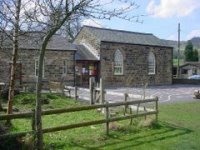
Combs School rents their use of schoolrooms in a building that began life as a Wesleyan Chapel in the nineteenth century. The building also serves as the Village Hall, which is the only community resource for Combs.

The building is managed and maintained by the Combs Village Hall Trust. Chair of the Trustees, Mike Evanson, commented: “Following the Council’s decision, we want to move on with exciting new environmental projects that will extend the use of the Village Hall. One good result of this campaign is that it has emphasised the wealth of diverse talent we have in the Combs area. A strong sense of community has been evident throughout this campaign, and people are saying ‘OK, what’s next?’”

Celebrating Success
“First things first, though.” said Nye Rowlands, “We need to say ‘thank you’ to everyone who has played a part in bringing the first stage of this campaign to a successful conclusion, and there will be a celebration at 7pm on 9th November at Combs School and Village Hall for everyone who has wanted to see this outcome.”

Full details of the planned celebration will be posted on the campaign’s web site, at save-combs-school.org.uk


Download a copy of the press release (56Kb Adobe Acrobat PDF format).

A Big Thank You

We'd like to say a sincere 'thank you' to:

  • All the people who signed the petitions, including the people of Chapel-en-le-Frith and Whaley Bridge, and the visitors to our village.

  • All the people who put up posters (and then took them down again in July, to keep the place tidy).

  • All the people who wrote letters to DCC.


  • The politicians who looked at the evidence and spoke up in support of the campaign. (High Peak Borough Council and its staff; Chapel-en-le-Frith Parish Council and its staff; Whaley Bridge Town Council; Barrie Taylor; Andrew Bingham; Tracy Critchlow; Tony Bingham and Steve Sharp).

  • Plain Talk Print in Glossop, who printed leaflets for us, and Staley's Dailies in Chapel-en-le-Frith, who helped to distribute them for us, both at no cost.

  • The governors and staff at nearby schools (Taxal & Fernilee; Kettlehulme; Chinley)

  • The people from the Plain English Campaign in Combs, who produced T-shirts, balloons and the DVD which gave people a real sense of what life in our valley is like.

  • The other organisations who backed us. (Peak District National Park Authority; Derbyshire Rural Community Council; and the Methodist Church)

  • Tom Levitt MP, who came to the school, and then asked questions of DCC.

  • The staff at DCC (in particular, Dee Hill and Dave Molyneux), who were very helpful in answering our many questions.

  • Prof. Chris Woodhead (former Chief Inspector of Schools, now University of Buckingham) for advice on the subject of educational standards.

  • The print and broadcast media who helped to keep the campaign visible. (Louise Bellicoso and everyone at Buxton Advertiser; Glossop Chronicle; High Peak Radio; Dave Guest at BBC North West; David Andrew at Primary Review; Derbyshire Times; Nicola Winship at Best of Buxton)


  • And perhaps most of all ... thanks to those who thought we could and should win, and never faltered in that opinion.

How The Decision Was Made

In the Cabinet meeting at County Hall today, Councillor Alan Charles opened his remarks about Combs School with, “I find myself in the unusual position of presenting a recommendation that I do not agree with, which is for Combs School not to be closed.”

In acknowledging that there had been a lot of opposition to the proposed closure, he complimented the campaigners (of which there were over 20 present) on their polite and courteous conduct of the campaign.

Alan CharlesHe referred to the Education Act 2005 (although that Education Act has been superseded by the Education Act 2006), saying that the school couldn't be closed because it could not be shown that doing so would improve educational standards in the area. Of course, we pointed that out to him when this process began: everything that has followed need not have happened.


Alan Charles maintained that the Act was “intended to protect small rural schools, not small schools for rural communities” and that, “even if the school roll was to fall to zero, the school still couldn’t be closed”. He’s completely wrong on the last point, and goodness only knows what he means by the first bit. We'll have to ask.

With regard to the quality of education at Combs School, he gave a nod to the work of Mrs. Curry and her staff. “Of course,” he said, “with double the funding that other schools get, I would not expect anything other than an outstanding education. You would rightly expect that of any school.”

Why does he continue with that argument? He’s been shown that it doesn’t cost “twice the average” to teach a pupil at Combs, and that there isn’t a clear correlation between money spent and the outcome for pupils. It’s only a few months since he tried to close a school that had a worse performance but a higher per-pupil cost – he must have forgotten that case.

Alan Charles made reference to having got hold of some numbers “ten minutes ago”, which showed that Combs School is “only serving seven children in the village”, and tried to depict it as a small school that, “if it relied on its catchment area, would not have enough pupils”.

We have no idea how he’s defining ‘village’ in that statement, or where his numbers come from. We gave him plenty of well-researched, detailed and accurate numbers. None of them agree with his presentation of the situation.

Two weeks ago, in closing another school, he maintained that there was no such thing as a catchment area, so his reversal of logic is baffling. As we’ve explained before, even the Council can’t explain how the ‘Normal Area’ for Combs is defined, and it bears no relation to the ‘Natural Area’ from which pupils come to the school. He doesn’t seem to understand that it’s in the nature of a rural area for people to be scattered about a bit. We’ve shown him that there is high demand for places at the school now and in the future. And of course, parental choice, a policy supported by the council, allows parents to request that their children go to schools that aren’t on their doorstep.

In closing, Alan Charles said, “I believe it was right for the Authority to propose the closure of Combs School, and it was right that we consulted as we have done. Very reluctantly, I move that the recommendation be accepted.”

The chairman asked for questions and comments. There were none.

The recommendation was put to a vote. A few of the councillors raised their hands an inch or two above the table, the chairman mumbled something, and the decision was made.

So, a conclusion to this completely unnecessary process has been reached. Now it’s time to get on with more positive things, as noted in the press release issued today.


UPDATE: 12 NOVEMBER

Read DCC's version of the meeting: download the meeting minutes.

This formal recording of the decision fails to convey the bad tempered and incoherent way in which the recommendation was presented.

This is the relevant excerpt.
505/07 COMBS INFANT SCHOOL – PETITION

A petition of 1,687 signatures had been submitted to the Authority, opposing the proposed closure of Combs Infant School.

RESOLVED to receive the petition opposing the proposed closure of
the Combs Infant School, as part of the consultation process.

506/07 PROPOSED CLOSURE OF COMBS INFANT SCHOOL

In outlining the background leading to the proposal of the closure of the Combs Infant School, the Strategic Director for Children and Younger Adults outlined the process undertaken for consultation, and in particular the procedures for closing a maintained school, bearing in mind not only the criteria for education and sufficient school places in the area but also the need to preserve access to the local school for rural communities. Whilst this did not preclude the closure of rural schools, it did mean that the case for closure should be strong, with proposals clearly in the best interest of educational provision in the area.

Issues raised during the consultation process included:-
  • standards of education;
  • effect on the village hall and community;
  • budgetary and financial considerations;
  • normal area and natural area;
  • parental choice;
  • consideration of alternatives to closures;
  • increased housing in the Chapel area;
  • portrayal of village;
  • surplus places issue;
  • school as provider of local employment;
  • ethos of school in balance against costs.
Arguably the single most important issue was that of standards and whilst the removal of surplus places supported the core agenda of raising standards, it was acknowledged that Combs Infant School provided a high quality of education, which many parents argued was the most significant for the future development of the child. Standards of education at Chapel-en-le-Frith C of E. Primary were deemed satisfactory by OfSTED, although there was the perception that because of its size, the quality of education was not as good at that provided by Combs Infant School. Some detail was given of the development of Chapel-en-le-Frith C of E. Primary where the quality and provision were improving.

Specific reference was made in the statutory guidance to the issue of standards and the need to ensure that the proposal for a school closure would lead to improved attainment for children and young people.

In accord with current legislation and the overriding concern that any proposal for closure has to be in the cause of raising standards of education, it was felt that the Authority should not proceed with the proposal to close Combs Infant School at this time, but the situation would be kept under review.

RESOLVED

(1) that the Authority does not proceed to the publication of Statutory Notices in respect of the proposed closure of Combs Infant School with effect from August 2008; and

(2) that situation regarding surplus places in this area of the County be kept under review.

Final Decision:
Combs Infant School is Saved!

A large group of campaigners attended the DCC Cabinet meeting in Matlock today.

The report on the school was presented by Alan Charles, and the Cabinet voted to accept the recommendation that Combs Infant School should not be closed.

Campaign supporters gathered outside County Hall after hearing the decision to keep Combs School open and were joined by Councillor Barrie Taylor and Andrew Bingham, Conservative Parliamentary candidate for High Peak

Saturday, 27 October 2007

“And that’s just not fair,
  is it, children?”

Cast your mind back to when this ghastly closure business started. DCC pointed out that Combs School spends more money per pupil than other schools. Of course, that wasn’t a comparison with similar schools, just a crude comparison with all primary schools in Derbyshire.

Do you remember Alan Charles talking about that at the consultation meeting? He talked of his solemn duty with ‘public money’, and the need to ensure that every child in Derbyshire got the same deal. He even explained this concept to the children of the school council, with a weird analogy about why they should feel guilty about getting more Mars bars than other schoolchildren. He ended with, “and that’s just not fair, is it, children?”

Well, let’s look at another example of the distribution of public money.

Each year, DCC’s councillors get a Basic Allowance which is “designed to cover the time commitment of all Members in all meetings including those with officers and members of the public. It is also intended to cover incidental costs such as the use of home and private telephone facilities”. On top of that, a Special Responsibility Allowance is “paid to those Members who perform special responsibilities in relation to the County Council”. The council decides who gets what.

Let’s select a councillor at random, and look at the allowances paid in 2006-07.

Alan Charles, the councillor responsible for schools, gets allowances of more than double the average paid to all DCC councillors. He gets almost three-quarters as much again as the average DCC cabinet member.

Now, that just doesn’t sound fair, does it, children?

But wait a minute. Maybe the allowance scheme has been carefully thought through. Maybe some councillors’ duties are more onerous than others. Maybe their circumstances are different, and they should rightfully claim certain additional allowances. When asked, maybe individual councillors, such as the one above, could give a believable explanation as to why they deserve a significantly above-average allocation of public money.

Although it might not be the right one, there is a plan for spending public money, we can all see what it is, and they’re working to that plan.

Well, guess what? That’s how school budgets are worked out too.

Combs School has been allocated a budget, based on a plan devised by central government and the local education authority. Part of it comes from a fund to protect small rural schools, whose vital role has been heavily acknowledged by government. For that, and other reasons, the allocation per pupil is higher than it is in large schools where economies of scale enable it to be lower.

So Combs School is being penalised for working within the plan devised by its critic – DCC.

And that really isn't fair, is it, children?

Friday, 26 October 2007

Tom Levitt Interviewed

High Peak Radio's web siteTom Levitt MP was interviewed on High Peak Radio this morning. The first part of the interview related to Tom Levitt being in the top ten of MPs claiming expenses in 2006-07. The second part related to the Save Combs School campaign. This is a very quick summary of that portion of the interview. While it isn't a verbatim transcript, it is hopefully accurate*.

High Peak Radio: Are you pleased by the decision to keep the school open?

Tom Levitt: Very pleased. I've always said that it would be the strength of the arguments that would decide the matter, and that's what's happened. A logical, sensible answer has been reached.

HPR: You've come in for a little criticism for not backing the campaign.

TL: It would have been very easy to jump in and believe what was being said by one side rather than the other, but I felt there were arguments on both sides. I met with the parents and governors, wrote to DCC, and asked a Parliamentary Question**. That got important information into the public domain. The answer to my PQ, which restated that there needed to be very strong grounds for closing excellent rural schools, is the very point on which DCC's decision is based. Doing what I did was the most supportive thing that could be legally done.

HPR: How do you respond to criticism that you've tried to claim credit for the campaign's success, unlike parish and borough councillors, who actually backed the campaign?

TL: It would have been very easy to jump in and get headlines about 'MP leads campaign', but as I've said, I thought there were arguments on both sides. If I had done that, perhaps the campaigners would complain now that I had claimed the campaign as my own. I played a large part in getting important information into the public domain which the campaign has been able to use***.

HPR: One questioner on the Save Combs School web site asks "How does Tom propose to halt or reduce the continuous and insidious rural community disengagement by DCC?"

TL: You have to remember that DCC has kept more small rural schools open than any other council. Cheshire, for example, tackled the problem of surplus school places some years ago and closed quite a few small schools. DCC still has to look at the problem of surplus places, though, and find a solution. That's what I meant earlier about there being arguments on both sides. DCC is doing a lot for rural communities. Look at the support for rural bus services, the commission set up to advise on protecting rural life, and the support given to ensure that postal services are still accessible even when a rural post office has to close because it isn't viable. There's a lot being done to support rural communities, and while I understand people's fears about those communities becoming dormitories, sometimes there are market pressures which can't be resisted.

*If anyone who listened to the interview thinks something's inaccurate or missing from this summary, please e-mail the webmaster.

** The exchange of letters between Tom Levitt and Alan Charles is in this post.

*** We previously described the request made to Tom Levitt to correct the factually incorrect information he disseminated. No response has been received to that request.

Use this link to find all posts that mention Tom Levitt.

Thursday, 25 October 2007

Reprieve for Peak School?

Read the story online in the Buxton Advertiser

Louise Bellicoso's report made the front page of the Buxton Advertiser today.

The story can be read online.

Tune In

High Peak Radio is the station to tune to today. Nye Rowlands (Chair of Governors) and Mike Evanson (Chair of Village Hall Trustees) were interviewed yesterday, and sound bites from the interview are appearing in the news bulletins.

High Peak Radio's web site

The station is on 103.3 and 106.4 FM.


Tom Levitt MP will be interviewed at 10:30 on Friday. What would you like him to be asked about the Save Combs School campaign? If you leave your question in a comment on this post, we'll pass it along to High Peak Radio and ask them if they can include it in the interview.

Wednesday, 24 October 2007

Another New Baby In The Village

We gave DCC lots of information about how many pupils there would probably be in years to come at Combs School. Our maps included dots for those yet to be born. We were given the information in confidence, and that's why we haven't published the maps, even though they were key pieces of evidence submitted to DCC.

Already during this campaign, two of the dots marked on the map we gave to DCC have become real live people.

And on the same day that DCC has announced their recommendation to keep Combs School open, it's wonderful to be able to report that another dot on the map has turned into a newly born baby.

He and his mother are doing fine. We send our congratulations.

DCC Issues Press Release

This has just been issued:

RECOMMENDATION TO KEEP SCHOOL OPEN
24 October 2007

Members of Derbyshire County Council’s cabinet are being recommended to keep open an infant school facing possible closure.

During an informal public consultation there were 180 letters and a petition with 1,687 signatures
[NOTE 1] opposing proposals to close Combs Infant School in Chapel-en-le-Frith.

When councillors meet on Tuesday 30 October they will be told that although the nearest alternative school, Chapel-en-le-Frith Primary School, provides a good quality education standards at Combs Infant School are currently higher. In its last Ofsted inspection Combs Infant School was rated ‘outstanding’.

As a result they do not believe there is a strong enough case to close Combs Infant School but are recommending that the problem of surplus places in the Chapel-en-le-Frith area is kept under review.

Councillor Alan Charles, Derbyshire County Council’s cabinet member for schools, said: “The purpose of the public consultation was to get the views of people in the Combs and Chapel-en-le-Frith area about the problems being caused by surplus places in the area.

“We have never had any concerns about the quality of education at Combs Infant School. The issue has always been whether it is fair to the tax payer and pupils at other schools in Derbyshire that it costs £5,447 to educate every pupil at Combs
[NOTE 2] compared to the county average of £2,635.

“The majority of pupils travel to Combs
[NOTE 3] which leaves surplus places available at their local community schools.

“Members of the cabinet will be able to look at all the responses from the consultation and the recommendations before taking a decision.”

Councillors will be told that there are also concerns about the impact that closing the school could have on the community as the building is used by a variety of local groups.

(Ref: JF.362.07) Media enquiries to John Fern on 01629 585234 or email john.fern@derbyshire.gov.uk

This press release repeats some inaccurate information that DCC has used previously, and which they've been asked to correct.

NOTE 1: There were 2141 signatories to the petitions, not 1687.

NOTE 2: It doesn't cost £5,447 per child. That's a budget figure, not an actual figure. We've explained that before.

NOTE 3: The majority of children, current and planned, live within Combs valley - the natural area for the school.

Andrew Bingham Expresses Delight At Recommendation

High Peak's Conservative Parliamentary Candidate, Andrew Bingham has spoken of his delight at the news that the recommendation to the DCC Cabinet meeting next week is not to close Combs Infant School.

Andrew said, "It is a tribute to all the residents, parents and activists that they have managed to force a change of heart from the County Council. Whilst it isn’t absolutely sorted until after the decision is made, we can only be pleased at the recommendation.

"It seems a long time since many of us attended the public meeting at the school, indeed, the huge attendance meant that the meeting was held outdoors, but all the work that has been done appears to have made the difference.

"I said from the start that the suggestion was unacceptable, badly conceived and illogical, and from the recommendation it now appears that DCC have come to the same conclusion. It is a shame that such a lot of public money has been spent on this when it was obvious from the start that closure was wrong.”

Andrew added, “As well as my own objections as the Parliamentary Candidate for the High Peak, I also objected on behalf of High Peak Borough Council following a discussion by its Social Inclusion Select Committee.

"I am sure that DCC, when faced by the weight of evidence accumulated by local people, must have realised what a mistake they were about to make. I reiterate, that I don’t want to pre-judge the decision, but the recommendation is there for all to see, and I fervently hope that the Cabinet at DCC follow it.”

Tuesday, 23 October 2007

DCC To Spare Village School

The following press release has been issued by the campaign.

Derbyshire County Council To Spare Village School From Closure

Combs, UK; 23 October 2007: In a report issued today by Derbyshire County Council, a recommendation has been made not to proceed with the closure of Combs Infant School, in High Peak, Derbyshire. The recommendation will go before the Council’s Cabinet for confirmation of the decision, on 30 October.

The report has been issued following a consultation process that began in May, in which the Council sought to solve their problem of having surplus places in other schools by closing Combs School.

The council received more than 2000 signatures on petitions, and almost 200 letters of opposition. Detailed arguments against the proposed closure have been set out on the campaign web site at save-combs-school.org.uk.

The campaigners have stressed, throughout the consultation, that Combs School was rated in September 2006 by Ofsted as “outstanding value for money”, and was unique in High Peak in providing an outstanding level of service in every category evaluated.

In their recommendation not to proceed, the Council has recognised that by closing the school, they would not – contrary to their statutory duty – be raising educational standards in the area.

Welcoming the report, parent governor Nick Boden commented: “Thankfully, common sense has prevailed, and we look forward to the Cabinet accepting the recommendation put forward by education officers.”

The Council’s recommendation also commented on the unusual arrangement whereby the same building is used for the school, as a village hall, and as a chapel.

“The School operates within a building maintained by the Village Hall Trust.” explained Chairman of the Trustees, Mike Evanson, “There’s a long history of the community providing financial support to the school, and we were very concerned that closing down the school would severely impact our ability to continue to operate the village hall on behalf of all who benefit from its use.”

The campaign opposing the proposed closure has drawn strong support, from within the community of Combs, and far beyond. All of the local parish and borough councils gave their support to the campaign to keep the school open, as did Peak District National Park Authority, Derbyshire Rural Community Council, and the Methodist Church.

The problem of surplus school places in the area will be kept under review by the Council. Chairman of the school Governors, Nye Rowlands, said: “This is undoubtedly good news, but we aren’t complacent, and know that we will have to sustain the strong community support, for this excellent school to continue to be spared the threat of closure.”

ENDS