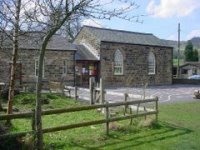
BROKEN LINKS: Some of the links in this site use the domain savecombsschool.org.uk.
Because the site is no longer maintained, those links no longer work.
But if you substitute that part of the page's address with savecombsschool.blogspot.com, they will work for you.
Sorry, but there's no time to go back and edit the whole site!

Saturday, 6 October 2007

Learning from Experience

Is education not all about widening horizons, broadening the mind? Certainly, in large part, it is. Through the eyes and ears of their head teacher, Avis Curry, the pupils of Combs Infant School have a window on Africa in their small reception hall in the heart of the Peak District. This area of the reception is frequently used for displays of the children’s work but, for now, it is an ‘interactive’ corner of Africa, a learning experience for all.

Mrs Curry has written eloquently about her time in Rwanda in an earlier post. It is well worth a read and puts us to shame in a number of areas – from the Rwandan attitude to plastic bags and recycling to the smiles on their faces despite suffering years of horror and hardship.

The children at Combs school smile a lot too. Not because they are smug and know how lucky they are, but simply because they are happy. They enjoy learning. Their teachers make it fun. They have a wonderful environment in which to develop a love of learning which they will hopefully carry with them through the rest of their lives. A lot of children in large, urban schools leave with quite another attitude. They are the ‘lost’ children of our education system. Victims of over-large classes, poor discipline, bullying and no natural beauty around them to inspire and energise them.

Small schools are like a large family. They share experiences together and they learn from them. They talk about things, they help each other. Mrs Curry was able to go to Rwanda confident in her team to look after the children she was leaving behind – and confident that the children wouldn’t let her down or misbehave in her absence. This sort of school is a blueprint for society. It would be a crime to shut it down – and extremely short-sighted.

Tuesday, 2 October 2007

Date Finally Set for Cabinet Review

The report on the proposed closure of Combs Infant School will go before DCC's Cabinet on 30 October 2007. A copy of the final report will be available to the campaigners on 23 October.

It will be posted on this site as soon as we get it. Remember to come back and look for it.

Do you want to attend the Cabinet meeting?
The Cabinet meeting will be in Matlock on 30 October, from 10:30am, for two or three hours. If you want to show your support for Combs School, Village Hall and Chapel, you might want to be there, to look the Cabinet up and down as they make their decision. If so, please e-mail the Webmaster, as soon as possible, to be added to the list. DCC needs to know how many people will attend.


P.S. We understand that the other three schools slated for closure will be considered by the Cabinet on 16 October, and that the first version of the report on Combs had to be redrafted before Cabinet could review it. We're trying to find out why.

UPDATE 04 October
The information we received was incorrect. The report sent to Alan Charles by David Humphrey was not a full Cabinet report, but a report on the consultation and the issues involved. It did not contain a recommendation. The full report for Cabinet is being worked on now, and will contain a recommendation for what action should be taken.

Friday, 28 September 2007

Reflections On Rwanda

Let's take a break from the long wait for DCC to make up their mind about the closure of our school, and find out what headteacher Avis Curry got up to in Rwanda.

Remember the goodbye messages that the children gave her, back in May? Here are Avis' reflections on Rwanda.


My time in Rwanda was an experience that I shall never forget. It was challenging, thought provoking, exciting, exhausting, fascinating and sad, all at the same time. So why did I go? After such a successful Ofsted report at Combs, as well as enjoying the moment, you ask yourself ‘what next?’ Some head teachers might look to ‘move on’, but I really enjoy what I do at Combs. So I saw this as an opportunity to refresh and revitalise my role as a school leader by revisiting my vision and values, whilst developing my leadership and management skills.

I was able to positively engage with capacity building at a strategic level whilst reflecting on my own current practice. Enriching the curriculum at Combs with my experiences as well as contributing to the global perspective, both at Combs and our cluster schools will be another benefit. So after all the excitement it is wonderful to return to Combs and carry on leading the teaching and learning here.

Lining up for classThe curriculum in Rwanda is not too dissimilar to our own and amazingly it is delivered without basic resources. The school to which I was attached had neither electricity nor running water, yet taught all subjects (except ICT!). From the age of about 8, all subject teaching is done through the country’s second language, French. All children from the age of 6 were taught 3 languages, English, French and Kinyrwanda (local dialect). They had few text books or pictures, no paints, crayons (etc), no formal music, but the sound and sight of the children singing, drumming and dancing was just wonderful. PE was football, volleyball or marching. Football is very big in Rwanda and English clubs are avidly followed, with the favourites being Manchester United and Arsenal. The children could tell me more about the players names and positions than I knew.

In the classroomMy remit was vast and unrealistic, but one of the foci was to improve the capacity of the school to improve, and yes, Rwanda also uses exam results to ‘league table’ their schools! Some of the problems faced were very reminiscent of the UK many years ago and from this aspect I felt most helpful as I could stop another head teacher from having to ‘re-invent the wheel’! Other areas of involvement were working with the parents and the community to improve the educational outcome for the children, training the teachers in current teaching methodology and starting up self-help cluster groups of schools, both within their own districts and across the country. So I was kept fairly busy!

Head teacher arriving at schoolI worked with my head teacher to introduce him to the computer and the internet. He now has an internet account and is keeping in touch through e-mail. Now he desperately wants a computer! It is amazing to think that in the middle of a very poor country, which is still recovering from the genocide, with an underfed and unemployed population, that you can find 2 or 3 internet cafes in the middle of a town. Where there is no electricity, people are using solar cells! The only bad thing about these cafes is that there was no protection against unsuitable sites and I often found children accessing explicit pornography and no one seemed to care, not even when I made an issue of it and threatened the police.

Living in Rwanda has made me realise that everybody doesn’t need to jump through the same hoops to develop. For instance Rwanda is very ‘green’. If you are lucky enough to have light bulbs then they are always low wattage. No plastic bags are allowed in the country, and just about anything you can think of is recycled or reused. Everyone grows food in any and every available space without pesticides (even if it is for the wrong reason - that they cannot afford them), and mobile phones are the norm. I don’t know that they will ever totally replace the landline grid and mobiles also double up as watches. It was worrying to observe the teachers picking up their mobiles in class and looking at them until I realised they were looking to see if it was time to change lessons.

Design & Technology ClassThe worst part of living in Rwanda was the feeling of inadequacy experienced when people talked of their experiences during the genocide and the thousands of children that have been left with absolutely no one to look after them. The lucky ones are orphans living with a relative, but for so many all the relatives were also killed and they are totally alone. So many children also have Aids and are not expected to become adults, so therefore are largely totally ignored.

Having lived in Rwanda I now really appreciate being able to turn on a tap and have a drink or a wash, and a hot shower is still a treat! Food was also a problem, as even when you could buy it I never quite mastered the kerosene stove, which repeatedly turned myself and the food black!

Always SmilingWhat I miss about Rwanda are the smiling faces; they have relatively little to smile about but a smile is always there. Perhaps I’d better not dwell on the warm sunny weather also (although it could be quite chilly morning and night.)

Avis Curry
October 2007


In case you're wondering, no-one from Rwanda has visited this blog yet. Of the 35 countries where visitors have come from, only three are in Africa: Morocco, Egypt and South Africa. There's lots of information on the web about education in Rwanda, so if you want to know more, start here.

Tuesday, 25 September 2007

Uncertainty Over Decision Day

During the consultation period, which closed on 6 July, we were told that DCC would review the results of the consultation and make a decision on what happens next by the end of September.

That became an expected date of mid October for a DCC Cabinet meeting. The reason we were given for the delay was that there was a large amount of documents and letters for DCC to process, and compile into a report.

But now we've learned that the DCC Cabinet members have not been able to set a date on which they will have finished 'gathering views' and will decide the fate of Combs Infant School, Village Hall and Chapel.

Meanwhile, our village school has opened for a new term and is operating as normally as it can, given its uncertain future.

The decision by DCC affects dozens of children, and scores of families, for a long time to come. We wish DCC would get on with their decision-making.

How hard can it be, for DCC to recognise that preserving a precious asset is the right thing to do?


A reminder of what can happen next...
Once DCC has (in their own good time) reviewed all of the input they received during the consultation period, their Cabinet, led by the member responsible for schools (Alan Charles, pictured right, defending the indefensible) will decide whether to press on (if they haven't come to their senses) and publish the formal notice of intended closure of the school. If they (stupidly) do that, there's then a further six-week period in which they will accept more input. At the end of that period, they decide whether to continue with the closure (against all reason).

So, be prepared for this to run on into (at least) 2008.

Read the post on "The Legal Framework" for more details.

Friday, 21 September 2007

Appalled... After All The Hard Work

Another letter to DCC.

I am a long-time resident of Combs, and I am writing to express my opposition regarding your proposal to close Combs Infant School.

In 1990 I was elected a parent governor of Combs Infant School and played an active and rewarding part in the school management. My daughter was part of the fourth generation of our family to attend the school with two of my grandchildren currently attending as pupils today.

During my second year as governor, a structural fault in the building was identified and four years later the toilet facilities were deemed inadequate.

The Village Hall Trust was formed to secure an agreement with the Methodist Church, who owned the building, in order to seek the necessary funding to correct the structural problems. In 1996, temporary toilet facilities were brought onto the site, and the Village Hall Trust set about the task of incorporating the new toilets into an enlarged and much improved School/Village Hall.

I am appalled that fifteen years later, after all the hard work (manual in some cases), and fund raising by our community you are considering closing this success story on the grounds of economy. The school has gone from strength to strength with amazing academic and social results.

It appears likely that the closure of the school could be profoundly damaging to the local community, to the survival of the current, vital facilities, and to village cohesion. The Village Hall provides a critical facility, regularly used by all age groups, and this would potentially be no longer available if the school was closed.

I urge you, considering all these factors, to reconsider this proposal.

Thursday, 20 September 2007

Village Life Is Gravely Threatened

This letter to DCC is from a Combs resident.

I am writing to add my voice to the many that are protesting against the authority's proposal to close our village school. I would like to draw attention to the wider role of the school and village hall as the focus of village life and our small community.

Combs is a rural farming community, the sort of village that keeps Derbyshire's tourist industry alive - yet the authority threatens to destroy the nature of the village that contributes to the wealth of the county as a whole.

In the last five years, Combs has lost its post office. We have not had a shop or newsagent in the village for many years. The library bus does visit once a week, but apart from that, the school and village hall is the only place where people can meet. Closing the school will damage the long term viability of the hall and strike yet another blow at rural life.

I do hope that my representatives on the county council do not knowingly destroy the fabric of life in the village that I enjoy living in so much.

Derbyshire County Council has a responsibility to those of us living in the rural parts of the county as well as those living in the county's towns and cities. I do not underestimate the challenges facing the county council but I think it would be a huge loss to the county as a whole if small communities like Combs become dormitories, with no local focus. Without the school and village hall, the fabric of our village life is gravely threatened.
DCC have had more than 200 letters about the proposed closure.

Wednesday, 19 September 2007

Manifestly a Happy School

This is another extract from the letter written to DCC by an ex-headteacher.

I understand that managing long-term issues like falling rolls is extremely difficult given short-term needs to balance annual budgets, but I would ask you to consider a long-term need which is of growing concern in the world of education and which will need to be addressed - namely, the happiness of children.

Any parent or teacher knows that children who are happy learn better than if they are distressed. Please therefore consider carefully not only the huge degree of distress that would be caused to the parents, children and community of Combs by the closure of its vigorously supported Infant School but the fact that it is manifestly a happy school.

In future years, given an unacceptable degree of unhappiness in the nation's school children, educational planners and teachers are going to have to give more thought to what makes children happy. Here at Combs you have a manifestly happy school, indeed the 'flagship' school that one of the parents mentioned. In many ways it could be the model for future infant schools and thought should be given to the notion that were Chapel Primary School smaller, it might well be better.

Balancing the books (and it's not as if a great deal of money is at stake here at Combs) is surely of less importance than the preservation of a school which has the secret of making children happy and wanting to learn. As Ofsted noted, it is a conspicuously successful school and you run the risk, by closing it, of replacing happiness - a rare thing in education - with unhappiness.

Can you really believe that you have picked the right school to close as you search for solutions to falling rolls (generally speaking) in the county?
Just a reminder: if you haven't already told DCC what you think about their plan to close an excellent school, write to them before they meet in October to decide the school's fate. Get involved: find out who to write to.